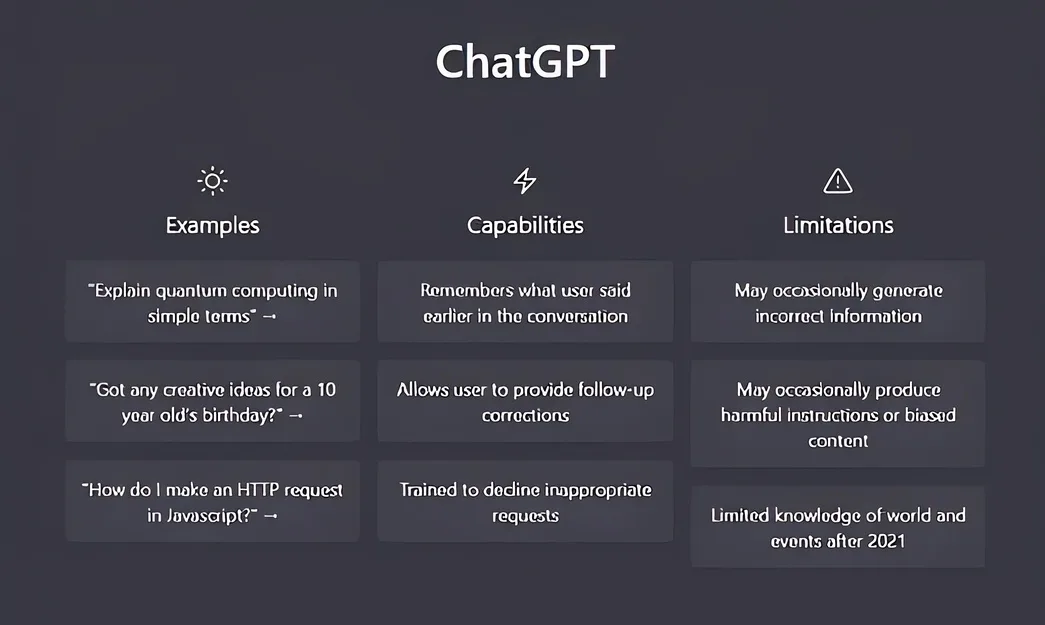
ChatGPT: The Star of AI with New Surprises

ChatGPT has become a global symbol of artificial intelligence for the general public. This conversational agent, developed by OpenAI, is not just a tool - it represents a cultural shift. Millions of people now interact daily with a machine that can generate essays, summarize texts, explain code, and even hold natural conversations. The occasional server saturation and media buzz demonstrate the extraordinary popularity of this tool. By offering free access early on, OpenAI strategically allowed people worldwide to “play” with the technology, sparking both curiosity and widespread adoption.
- Technical Operation of ChatGPT and GPT-4 -
At its heart, ChatGPT is based on the Generative Pretrained Transformer architecture, a neural network model that processes and generates human-like text. This architecture is part of the transformer family, first introduced in 2017, which has since revolutionized natural language processing (NLP). Transformers excel because they use the attention mechanism, allowing them to weigh different parts of a text sequence and capture complex dependencies between words.
GPT-4, the successor to GPT-3, contains hundreds of billions of parameters, making it one of the most powerful language models ever deployed. Parameters are essentially the "knobs" of the neural network - values learned during training that help the model associate text patterns with meaning. The larger the number of parameters, the more nuanced and context-aware the model's responses become. More recently, GPT-4o (the "o" stands for "omni") extended these capabilities to handle images, audio, and video in a single unified model, enabling real-time voice conversations and visual understanding within the same ChatGPT interface.
Another key innovation is Reinforcement Learning from Human Feedback (RLHF). After pretraining on massive text corpora, GPT-4 undergoes fine-tuning where human reviewers evaluate its answers, ranking them for quality and safety. This reinforcement loop improves conversational ability and reduces the likelihood of harmful or nonsensical responses. In short, RLHF gives ChatGPT its “human touch,” aligning the model’s output with socially acceptable communication patterns.
- Notable Advancements and Capabilities -
ChatGPT’s versatility is what sets it apart. Now powered by GPT-4, it is capable of performing tasks that range from academic to creative, including:
- Answering factual and conceptual questions across virtually any domain
- Summarizing complex documents or explaining scientific concepts in simple terms
- Correcting grammar and syntax in written text, helping users improve communication
- Generating code snippets in multiple programming languages
- Debugging software and suggesting algorithmic improvements
- Engaging in creative writing tasks such as poetry, storytelling, or roleplay
- Browsing the internet for up-to-date information (for users with GPT-4 browsing mode enabled)
- Integrating with over 400 plugins for specialized tasks (travel booking, financial analysis, data visualization, etc.)
This multi-functionality makes ChatGPT more than just a chatbot: it is a general-purpose assistant that augments human productivity. For students, it can clarify academic concepts. For professionals, it can draft reports, analyze datasets, or automate routine tasks. For creatives, it can generate storyboards, lyrics, or even simulate debates.
- Cultural Impact and Everyday Use -
The release of ChatGPT sparked a global conversation about AI’s role in daily life. For the first time, millions could experience an advanced language model outside research labs. This accessibility democratized AI, allowing teachers to use it in classrooms, businesses to accelerate customer support, and individuals to explore creativity. It has also fueled debates: Should students use ChatGPT to help with homework? Can journalists rely on it for drafts? Should programmers accept AI-generated code without verification?
In practice, the tool has already become a digital co-pilot for knowledge work, much like calculators are for mathematics. Its integration into Microsoft’s Copilot ecosystem (Word, Excel, PowerPoint) is a glimpse of a future where generative AI is embedded into everyday productivity tools.
- The Challenge of Bias and Safety -
Earlier conversational AIs like Microsoft Tay and Meta’s BlenderBot failed due to biased, offensive, or harmful outputs. These failures underscored how easily AI can reflect toxic content from the internet. OpenAI tackled this with RLHF and the Moderation API, which filters out unsafe content such as hate speech, misinformation, or harmful instructions.
Despite these safeguards, bias remains a challenge. Since GPT-4 learns from internet-scale data, it inevitably absorbs cultural biases, stereotypes, and errors. Mitigating these requires constant updates, better feedback loops, and transparency in how models are trained and deployed. Ethical questions remain: Should AI outputs be considered original? Who is responsible if an AI-generated suggestion causes harm?
- Economic and Educational Implications -
ChatGPT is transforming industries at an astonishing pace. In education, it can act as a personal tutor, adapting explanations to a student’s learning style. In healthcare, it assists doctors with summarizing patient records or drafting discharge notes. In business, companies use it to automate customer service, draft marketing content, and analyze data. Some predict it will add trillions of dollars in productivity to the global economy.
Yet, this disruption raises concerns about job displacement. Roles centered on repetitive tasks, like call-center work or basic content writing, may be increasingly automated. At the same time, new opportunities are emerging: prompt engineers, AI trainers, and ethicists are in growing demand. The balance between efficiency and employment is one of the central challenges of the AI era.
- OpenAI’s Reasoning Models: o1, o3, and the Chain-of-Thought Revolution -
In September 2024, OpenAI launched a fundamentally different kind of model: o1. Where GPT-4 responds immediately, o1 pauses to "think" - generating a hidden internal chain-of-thought before producing a final answer. This allows the model to decompose hard problems, backtrack when reasoning fails, and verify intermediate steps. The result was dramatic: o1 placed in the top 500 of the USA Mathematical Olympiad and scored at PhD level on physics, chemistry, and biology benchmarks.
o3 (December 2024) pushed even further. On the ARC-AGI benchmark - a test specifically designed to resist pattern-matching by requiring genuine abstraction - o3 achieved 87.5% accuracy, compared to 17% for GPT-4o. On Codeforces competitive programming, o3 ranked in the 99.9th percentile. These results reignited debate about how close AI systems are to human-level general intelligence.
The key architectural difference is test-time compute: reasoning models are trained and deployed to spend more computational effort per query. The longer they "think," the better they perform on hard tasks. This represents a shift from the scaling law (bigger training data/more parameters → better model) toward a new axis: more inference-time reasoning per answer.
- ChatGPT’s Feature Ecosystem in 2024–2025 -
ChatGPT has evolved from a single chat window into a rich productivity platform. Here are the major features that launched between 2024 and 2025:
- Memory: ChatGPT can now remember facts across conversations - your name, preferences, projects you’re working on - and apply them in future sessions. Users control what is remembered and can clear memory at any time.
- Projects: A workspace feature that groups related conversations under a shared context and uploaded files. A project for "Q4 financial report" retains all relevant documents and chat history, making ChatGPT more useful for sustained, multi-session work.
- Canvas: A side-by-side document editor where ChatGPT writes collaboratively in real time. Users can highlight a sentence and ask for improvements, change the tone, or adjust the reading level - without rewriting the entire prompt.
- Advanced Voice Mode: GPT-4o’s native audio processing enables natural, low-latency voice conversations with emotional range - laughter, pacing, tone changes - making it the first mainstream AI voice assistant that feels genuinely conversational rather than robotic.
- Sora integration: OpenAI’s video generation model Sora became accessible to ChatGPT Plus subscribers, enabling text-to-video generation directly within the chat interface.
- Operator & Agents: OpenAI’s Operator (January 2025) allows ChatGPT to control a web browser autonomously - filling forms, booking tickets, navigating sites - without human interaction for each step.
- GPT-5 and What Has Changed in 2025 -
GPT-5 launched in May 2025, fulfilling and exceeding earlier expectations. Its key innovation is the unification of the GPT-4o and o-series lineages: users can toggle "thinking" on or off per request, getting fast conversational responses for simple tasks and deep reasoning for hard ones - all within a single model. This eliminates the need to manually choose between the chat model and the reasoning model.
GPT-5 also introduced a new tier of multimodal reasoning: it can watch a video, understand a complex diagram, and reason about both simultaneously. Benchmark results showed it significantly outperforming GPT-4o on coding (SWE-bench), graduate-level STEM (GPQA Diamond), and long-document understanding tasks.
One thing is clear: from GPT-1’s 117 million parameters in 2018 to the unified reasoning system of 2025, ChatGPT has marked the beginning of a new era in human-computer interaction. Whether as a tool, a teacher, or a collaborative agent, it continues to redefine the boundaries of what machines can do.
- GPT Model Evolution: Key Numbers -
| Model | Release | Parameters | Context | Key innovation |
|---|---|---|---|---|
| GPT-1 | Jun 2018 | 117 M | 512 tokens | Unsupervised pre-training + supervised fine-tuning |
| GPT-2 | Feb 2019 | 1.5 B | 1,024 tokens | Zero-shot task transfer; initially withheld for safety |
| GPT-3 | Jun 2020 | 175 B | 2,048 tokens | Few-shot in-context learning; trained on 570 GB text |
| GPT-3.5 | Mar 2022 | ~175 B | 4,096 tokens | RLHF alignment; ChatGPT launch (Nov 2022) |
| GPT-4 | Mar 2023 | Undisclosed (est. 1.7 T MoE) | 8K / 32K tokens | Multimodal (text + images), improved reasoning |
| GPT-4o | May 2024 | Undisclosed | 128K tokens | Omni: native audio/image/video, 2× faster, 50% cheaper |
| GPT-4o mini | Jul 2024 | Undisclosed | 128K tokens | Low-cost, fast; replaced GPT-3.5 as the free-tier model |
| o1 | Sep 2024 | Undisclosed | 128K tokens | Reasoning-first: internal chain-of-thought; top math/science benchmarks |
| o3 | Dec 2024 | Undisclosed | 200K tokens | State-of-the-art on ARC-AGI, Codeforces, AIME; extended thinking time |
| GPT-5 | May 2025 | Undisclosed | Undisclosed | Unified model: merges GPT-4o capabilities with o-series reasoning in one model; supports "thinking" mode toggleable per request |
The jump from GPT-3 to GPT-4 represents roughly a 10× increase in total parameters (via Mixture of Experts), but only ~220 billion are active per forward pass. This sparse activation is what makes GPT-4 efficient enough for real-time conversation despite its scale.
- How RLHF Aligns ChatGPT - Step by Step -
Reinforcement Learning from Human Feedback (RLHF) is the process that transforms a raw language model into a helpful, harmless assistant. Here is how it works:
- Supervised Fine-Tuning (SFT): Human annotators write ideal responses to a curated set of prompts. The base GPT model is fine-tuned on these demonstrations, learning the expected format and tone of a conversational assistant.
- Reward Model Training: Annotators are shown multiple model outputs for the same prompt and rank them from best to worst. A separate neural network (the reward model) is trained on these comparisons using the Bradley-Terry preference model, learning to assign a scalar score to any output.
- PPO Optimization: The SFT model is further trained using Proximal Policy Optimization (PPO). In each iteration, it generates a batch of responses, the reward model scores them, and the policy is updated to maximize reward - subject to a KL divergence penalty that prevents it from straying too far from the SFT baseline.
- Iterative Refinement: Steps 2–3 are repeated with fresh prompts, updated guidelines, and red-team testing. OpenAI employs external red-teamers to deliberately probe the model for harmful, biased, or deceptive outputs, feeding these findings back into training.
This pipeline - described in detail in OpenAI's InstructGPT paper (Ouyang et al., 2022) - is what gives ChatGPT its characteristic helpfulness while reducing (though not eliminating) harmful outputs.
- References -
- Radford, A. et al. (2018). "Improving Language Understanding by Generative Pre-Training." (GPT-1)
- Radford, A. et al. (2019). "Language Models are Unsupervised Multitask Learners." (GPT-2)
- Brown, T. et al. (2020). "Language Models are Few-Shot Learners." arXiv:2005.14165. (GPT-3)
- Ouyang, L. et al. (2022). "Training language models to follow instructions with human feedback." arXiv:2203.02155. (InstructGPT / RLHF)
- OpenAI (2023). "GPT-4 Technical Report." arXiv:2303.08774.
- OpenAI (2024). "Learning to Reason with LLMs." OpenAI Blog. (o1 system card)
- ARC Prize Foundation (2024). "ARC-AGI-1 Public Leaderboard." arcprize.org.
- OpenAI (2025). "GPT-5 System Card." OpenAI Blog. (May 2025)
- Frequently Asked Questions -
Q: How many parameters does GPT-4 have?
OpenAI has not officially disclosed GPT-4's parameter count. Leaked reports suggest it uses a Mixture of Experts architecture with approximately 1.7 trillion total parameters, of which about 220 billion are active per forward pass - making it far more efficient than a dense model of equivalent size.
Q: What is the difference between GPT-4 and GPT-4o?
GPT-4o ("omni") processes text, images, and audio natively in a single unified model, whereas GPT-4 handled different modalities through separate pipelines. GPT-4o is also approximately 2× faster and 50% cheaper on the API, with a 128K token context window (vs. 8K/32K for GPT-4).
Q: Is ChatGPT's training data up to date?
No. GPT-4 has a knowledge cutoff date (originally September 2021, later extended to April 2023 in updates). ChatGPT Plus users can enable web browsing for real-time information retrieval, but the base model itself does not know about events after its cutoff.
Q: Can ChatGPT write and execute code?
Yes. ChatGPT with Code Interpreter (renamed "Advanced Data Analysis") can write Python code, execute it in a sandboxed environment, and return results including charts, tables, and downloadable files. This makes it useful for data analysis, visualization, and prototyping without needing a local development environment.
Q: What is the difference between o1/o3 and GPT-4o?
GPT-4o is optimized for speed and breadth - it responds in under a second and handles text, images, and audio natively. o1 and o3 are optimized for depth and accuracy on hard problems: they generate a private chain of thought before answering, spending seconds or minutes "thinking." For everyday questions, GPT-4o is better (faster, cheaper). For complex math, coding challenges, or scientific reasoning, o1/o3 are significantly more accurate.
Q: What is GPT-5 and is it available?
GPT-5 launched in May 2025 and is available to ChatGPT Plus, Pro, and API users. Its key innovation is unified reasoning: it combines the broad capabilities of GPT-4o with the chain-of-thought reasoning of the o-series into a single model. Users can request "thinking" mode for hard tasks and fast mode for simple ones, without switching models. GPT-5 significantly outperforms GPT-4o on coding (SWE-bench), STEM (GPQA Diamond), and long-context tasks.
Q: What is ChatGPT Operator and what can it do?
Operator (launched January 2025 for Pro users) is an agentic feature that gives ChatGPT control of a web browser. It can navigate websites, fill in forms, complete purchases, book reservations, and execute multi-step web tasks autonomously. It runs in a sandboxed browser session and pauses to ask for confirmation before sensitive actions (like payments), maintaining human oversight while dramatically reducing repetitive web work.
Comments